Noir social deduction · Free to play
Build the case. Read the room. Survive the verdict.
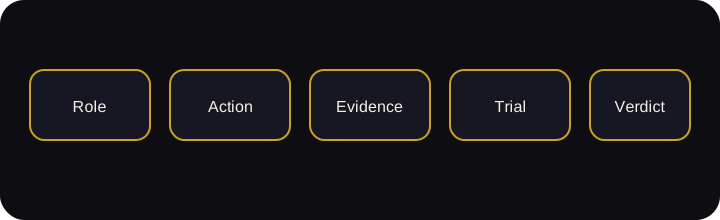
Verdictris turns a hidden-role match into a living courtroom story. Every seat has a private role and objective, every action leaves uncertain traces, and every public trial asks whether the table can separate evidence from a convincing lie.
Play solo against AI opponents; supported multiplayer builds also offer synchronized matches. Success depends on how well you connect movement, testimony, dice outcomes, resources, and motive—not on reflexes or buying an advantage.
What makes a match different
A deduction game where mechanics become testimony
Roles create different kinds of proof
Investigators build leads, protectors preserve credible voices, attackers create risk, economy roles manipulate leverage, and social roles influence what the courtroom believes. A claim matters only when its timing and results fit the public record.
Actions are contested
Many attacks, defenses, investigations, and interventions are resolved through opposed dice and modifiers. A miss is not proof of innocence, a success is not automatic proof of guilt, and counterplay can change the story after a declaration.
The city remembers proximity
The crime map, taverns, relocation trails, case files, and forensic profiles turn location into context. Weak clues guide questions; repeated, compatible clues can become a trial-ready case.
The courtroom resolves pressure
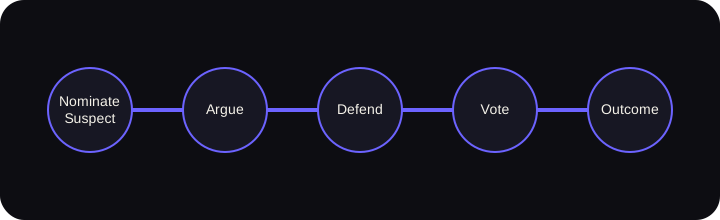
Players nominate suspects, present accusations and defenses, weigh admissible public evidence, and vote. Plea bargains can turn a guilty outcome into detention, while an unsupported rush to judgment may hand control to the wrong faction.
A first-cycle example
One event can support several honest explanations
Imagine that Rowan moves near the river district, declares an investigation, and later appears beside a suspicious incident. The outcome feed shows that the investigation produced only a weak lead. Another player argues that Rowan caused the incident; Rowan says the movement was necessary to investigate it.
A careful table does not treat proximity as a conviction. It asks whether Rowan's declared target matched the route, whether the weak lead is consistent with the claimed job, who else had opportunity, and who benefits from forcing an early vote. On the next cycle, a second compatible clue may strengthen the case—or reveal that the first accusation was a frame.
This is the core Verdictris rhythm: actions create signals, signals create competing stories, and trials test which story accounts for the most public facts with the fewest convenient exceptions.
Continue with the guide that answers your next question
A complete walkthrough of setup, phases, dice, evidence, the map, market, trials, pleas, verdicts, and a first-match checklist.
Every current role, grouped by alignment, with its public purpose, signature tools, risks, and counterplay.
Concrete plans for each faction, case construction, resource timing, forensic reasoning, and late-game decisions — including how to talk to the AI in court with worked examples.
Build fair nominations, test accusations, answer with a timeline, deliberate, vote, and understand plea-adjusted verdicts.
Separate private leads from public proof and connect routes, witnesses, traces, profiles, and case files.
Value bids, buy-now weapons, cash reserves, equipment slots, uses, timing, and the evidence a purchase can create.
Read Good Luck minus Bad Luck, opposed totals, margins, modifiers, defenses, and honest probability claims.
Verdictris is intended for teens and adults and includes social deception, crime themes, simulated trials, and non-graphic violence.