Role encyclopedia
Every Verdictris role, its pressure points, and its counterplay
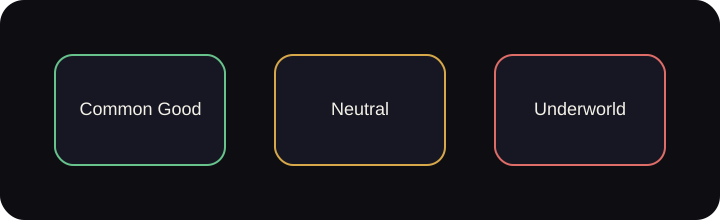
Verdictris currently has 33 selectable roles. Each one changes how a player gathers evidence, controls the crime map, survives attacks, influences the courtroom, or advances a private objective. This guide follows the same alignment and faction order shown by the canonical role registry.
The descriptions below explain public rules and practical play. They do not reveal private match state, secret targets, hidden visits, or information that a seat could not legitimately know. A role claim is an argument, not proof: compare it with public logs, admissible evidence, timing, and the claimant's earlier choices.
How to read a role
Purpose and win approach describes what the seat is trying to accomplish, not what the table should automatically believe. Common Good wins through the civic side's victory, hostile factions seek vote parity or the removal of key Good roles, and most Neutral roles have survival plus a personal milestone. Hitman is a special unaffiliated Neutral freelancer with a sustained contract campaign.
Signature tools names the role's defining actions or passive. Outcomes still depend on declared targets, legal visibility, charges, equipment, opposing rolls, map state, and other defenses. Risk and counterplay explains how opponents can test the claim using public behavior without assuming access to hidden truth.
Alignment: Good · Faction: Common Good
Common Good roles
Common Good seats win by eliminating Organized Crime or securing the civic victory condition. Their power comes from combining independent leads, custody, protection, and public process. Their recurring danger is converting suspicion into certainty too early.
Citizen
- Purpose and win approach
- Build a trustworthy civic record and help the Common Good eliminate Organized Crime or outvote it. Citizens are numerous, so disciplined observations and votes matter even without official authority.
- Signature tools
- Neighborhood Watch and Tip Line create leads, Civic Testimony turns useful knowledge toward court, and Block Captain applies local control. The kit rewards patient information play rather than dramatic solo claims.
- Risk and counterplay
- A Citizen can mistake a weak clue for a solved case. Compare the claimed observation with map timing and later evidence; hostile players should be challenged on contradictions, not treated as guilty merely because they visited a busy district.
Crime Watch
- Purpose and win approach
- Monitor neighborhoods, identify suspicious activity patterns, and help the Common Good focus its limited investigative attention.
- Signature tools
- Crime Watch Patrol observes a chosen map area, while Community Alert can disrupt a suspect's operation window. Shared bounty-evidence support can also help a living Bounty Hunter evaluate a target.
- Risk and counterplay
- Busy cells naturally produce noisy visitor lists. Ask whether a patrol result identifies a meaningful pattern or just presence, and watch whether alerts consistently protect the table or conveniently suppress inconvenient players.
Governor
- Purpose and win approach
- Use statewide authority to preserve civic options, strengthen trusted Good seats, and prevent a single bad trial or violent night from deciding the match.
- Signature tools
- Veto / Curfew changes high-stakes public outcomes, Executive Task Force supports a trusted Good role, State Patrol protects a district, and Civic Mandate raises citywide pressure against violent or covert play.
- Risk and counterplay
- Executive power is scarce and publicly consequential. Demand a clear reason for the protected district or commissioned player; hostile players can bait premature use, but a later disagreement is not by itself proof that the Governor was corrupt.
Informant
- Purpose and win approach
- Develop hard-to-see movement and communication leads, then pass useful intelligence into Common Good channels without becoming an easy target.
- Signature tools
- Tail / Bug follows a suspect, Wire Tap establishes map-based surveillance, Dead Drop passes protected intelligence, and Public Evidence can advance a legitimate forensic profile.
- Risk and counterplay
- Covert leads are easy to overstate. Ask the claimant to separate what was directly learned from what was inferred, and compare any later public-evidence submission with the earlier story. Do not demand disclosure of private network information that would expose allies.
Investigator
- Purpose and win approach
- Assemble a defensible case from location clues, interviews, and forensic profile progress so the Common Good can act on more than suspicion.
- Signature tools
- Investigate examines a map location, Canvass develops a follow-up lead, and Public Evidence moves collected profile information into an admissible civic record. The Investigator also begins with practical field equipment.
- Risk and counterplay
- An investigation result is evidence of a pattern, not an automatic identity reveal. Test whether the target, location, and timing were declared consistently. Frame jobs, tampering, and crowded scenes make corroboration especially important.
Judge
- Purpose and win approach
- Protect the integrity of the courtroom and use legal authority to convert credible leads into orderly, reviewable decisions for the Common Good.
- Signature tools
- Court Order and Chamber Review shape legal process and evidence review. Bench Warrant can schedule a revealed suspect for a later trial round, while Civic Mandate and Public Evidence support broader civic enforcement.
- Risk and counterplay
- Authority can amplify a weak case as easily as a strong one. Scrutinize the evidence cited when a warrant or order is used and distinguish lawful sequencing from an attempt to rush the table past unresolved contradictions.
Mayor
- Purpose and win approach
- Turn civic influence into stable votes, targeted district scrutiny, and economic access that helps the Common Good survive a long campaign.
- Signature tools
- Double Vote / Special Vote changes public voting leverage, Civic Outreach reads district sentiment, Press Conference places a district under scrutiny, and Civic Mandate supports the city's lawful response. City Hall leverage also improves the Mayor's market prices.
- Risk and counterplay
- Public influence attracts manipulation. Track whether the Mayor announced a coherent reason before spending vote power, and check whether district scrutiny follows evidence or merely creates a stage for a preferred narrative.
Police Chief
- Purpose and win approach
- Coordinate civic enforcement, expose urgent threats, and direct the Common Good's scarce control and evidence resources.
- Signature tools
- Emergency Order, Night Directive, and All Points Bulletin provide public leadership and operational direction. Civic Mandate, shared bounty evidence, and Public Evidence connect command decisions to the wider case.
- Risk and counterplay
- A false Chief claim can steer several seats at once. Ask for a consistent record of directives and public consequences, but remember that failed contests do not prove a false claim. Judge leadership by target logic and corroboration.
Police Officer
- Purpose and win approach
- Create lawful control over credible suspects, collect neighborhood information, and help the Common Good turn a scattered case into enforceable pressure.
- Signature tools
- Detain and Arrest provide escalating control, while Patrol Report and Canvass gather map-facing leads. The role can also share target-specific bounty evidence with a living Bounty Hunter.
- Risk and counterplay
- Control used on the wrong seat can erase a vital action. Require a reason tied to public facts, compare repeated targets with the evolving case, and avoid treating a temporary detention as a verdict.
Police Sergeant
- Purpose and win approach
- Improve the reliability of other civic actions and keep the Common Good coordinated when individual clues are incomplete.
- Signature tools
- Assist and Training Drill strengthen operational readiness, Field Brief develops location intelligence, and shared bounty evidence can help a Bounty Hunter pursue a properly supported suspect.
- Risk and counterplay
- Support can hide inside another player's claim, making it hard to verify. Compare the Sergeant's stated support plan with later outcomes and ask why one seat was prioritized, while allowing for contests that legitimately miss.
Sheriff
- Purpose and win approach
- Translate a warrant-backed case into decisive force while still contributing patrol information to the Common Good.
- Signature tools
- Warrant Shot is a weapon-backed offensive action, Sheriff Patrol develops map evidence, and shared bounty evidence helps establish target-specific pursuit. The role starts armed, but weapon uses remain a limited resource.
- Risk and counterplay
- A shot is consequential and can create forensic or public traces. Demand a credible warrant theory before accepting the target choice. Protective interception, armor, and ordinary counter-fire rules may matter; a claimed miss alone does not confirm either role.
Alignment: Neutral · Faction: Neutral
Independent Neutral roles
These roles are not automatically members of either major side. Most need to survive and complete a personal milestone. Their public actions can genuinely help another faction, but the table should still ask how each choice advances the Neutral seat's own objective.
Body Guard
- Purpose and win approach
- Survive and successfully intercept a kill, or remain alive to the end. The Body Guard creates uncertainty for attackers by making an obvious target harder to reach.
- Signature tools
- Guard / Intercept answers a fatal threat, Threat Assessment reads danger, Safe House Detail prepares protection, and Crowd Cover protects through a selected location. Starting defensive equipment supports the bodyguard role.
- Risk and counterplay
- Predictable guards let attackers move elsewhere, while fabricated guard claims can explain any survival. Compare declared priorities and threat assessments over time; do not assume every prevented attack must become publicly attributable.
Bounty Hunter
- Purpose and win approach
- Complete two target contracts by building target-specific evidence before committing limited weapon uses.
- Signature tools
- Track develops bounty evidence, Pin Down controls a target, and Bounty Shot requires a usable weapon plus enough evidence on that specific suspect. Public Evidence and evidence shared by eligible civic roles can strengthen the pursuit.
- Risk and counterplay
- The contract creates an incentive that may diverge from the table's priorities. Ask whether the Hunter demonstrated a real evidence trail instead of reverse-engineering one after a shot, and protect a likely target when the pursuit becomes obvious.
Driver
- Purpose and win approach
- Survive and successfully reroute an attack, or reach the end alive. The Driver manipulates position and route pressure rather than proving alignment directly.
- Signature tools
- Swap Positions uses exactly two targets, Route Recon studies movement, Getaway Car changes escape dynamics, and Roadblock controls a map location.
- Risk and counterplay
- Rerouting can save a player or place someone else in danger. Ask for the pre-action reasoning and compare it with known routes. A convenient post-hoc story deserves scrutiny, but unusual movement can also be legitimate defensive play.
Jailer
- Purpose and win approach
- Survive and successfully jail an Evil player, or remain alive to the end. The Jailer creates a controlled space for custody, questioning, and negotiated outcomes.
- Signature tools
- Jail establishes custody; Cell Interview, Charge Suspect, and Parole Deal develop that interaction. Execute Detainee is a severe option with narrow consequences, not a routine substitute for a public case.
- Risk and counterplay
- Jailing an innocent seat suppresses useful actions and creates coercive leverage. Track whether custody choices follow evidence. Private interview claims should be weighed cautiously because the wider table cannot independently see the entire exchange.
Journalist
- Purpose and win approach
- Survive, land two verified leads, and complete one successful public expose. The Journalist wins by turning investigation into information the whole table can evaluate.
- Signature tools
- Follow Lead develops a story, Publish Expose makes a public intervention, and Public Evidence advances forensic profile information through a recognized process.
- Risk and counterplay
- The need for a successful expose rewards attention-grabbing timing. Check whether the published claim grows from earlier leads and independent evidence. A loud headline with no chain of reasoning should not outweigh a quieter, better-supported case.
Lawyer
- Purpose and win approach
- Survive while either preserving a client or contributing to an incorrect execution. The Lawyer's incentives can align with due process in one trial and diverge sharply in the next.
- Signature tools
- Objection, Case Consult, Jail Visit, and Suppress Evidence reshape courtroom preparation. Plea Motion can pursue a negotiated result: when a plea bargain is accepted, a guilty trial outcome becomes detention rather than execution.
- Risk and counterplay
- Legal advocacy is not proof that the client is innocent or guilty. Evaluate whether the Lawyer identifies actual weaknesses in the case. Track abrupt changes in whom they protect, especially when those changes conveniently advance a personal objective.
Medic
- Purpose and win approach
- Survive and successfully save at least one player. The Medic preserves critical seats while gathering limited medical and forensic context.
- Signature tools
- Protect / Stabilize covers a map cell for emergency aid, Triage Scan assesses a patient, and Autopsy examines a dead player's last location. The starting Second Wind utility supports recovery.
- Risk and counterplay
- Protection claims are difficult to prove when no attack occurs. Compare treatment choices with public injuries and likely threats, and remember that autopsy information is still a lead that must be integrated with the rest of the case.
Spy
- Purpose and win approach
- Survive, broker at least two intel sales, and land one successful fabrication. The Spy thrives when several factions value the same fragment differently.
- Signature tools
- Collect Evidence obtains tradeable material, Sell Information turns knowledge into leverage, and Fabricate Evidence creates the deception milestone at the heart of the role.
- Risk and counterplay
- Buyers should distinguish actionable shadow intel from trial-admissible evidence. Cross-check any sold claim before voting on it, record whether the Spy's versions change by audience, and avoid disclosing more private information than a trade requires.
Vigilante
- Purpose and win approach
- Survive and personally eliminate an Evil player, or survive to the end. The Vigilante turns an independent read into direct pressure but bears the cost of being wrong.
- Signature tools
- Stakeout develops a target profile, Wanted Poster marks a public suspect, Warning Shot applies nonlethal pressure, and Shoot is a weapon-backed attack. The last weapon use receives the role's desperate overdrive floor.
- Risk and counterplay
- Violence can erase a Good or useful Neutral seat before trial. Demand a visible progression from observation to target choice. Protection and ordinary shot defenses remain relevant, and forensic traces can help test competing claims afterward.
Alignment: Neutral · Faction: Neutral / Freelancer
Unaffiliated freelancer
The Hitman sorts separately because the role is always unaffiliated. It does not gain allied-network membership, operational support targeting, or mutual chat from another alignment label.
Hitman
- Purpose and win approach
- Survive and complete a sustained contract campaign. The Hitman works as a Neutral freelancer, not as a member of Common Good, Criminal Crew, or Organized Crime.
- Signature tools
- Assassinate uses the signature Sniper Rifle against the contract target, Self-Defense answers threats, Arms Trafficking supports the freelance economy, and Post Bounty develops private contract intelligence. Assassinate is non-counterable: its target never returns counter-fire against that assassination shot, whether it misses, grazes, is blocked, or is otherwise prevented.
- Risk and counterplay
- Non-counterable does not mean unstoppable. Legal targeting, limited information, protection, prevention, and the Hitman's need to manage contract exposure still matter. Watch for target-focused behavior and bounty activity, but do not invent an allied network around the role.
Alignment: Evil · Faction: Criminal Crew (Mutuals)
Criminal Crew mutuals
These roles pursue hostile parity or the removal of key Common Good seats through mutually aligned criminal pressure. Their strengths span violence, economic destabilization, falsified records, and map sabotage. Counter them by joining independent evidence chains rather than chasing every isolated disturbance.
Arsonist
- Purpose and win approach
- Advance the Criminal Crew's hostile victory while escalating district danger, economic pressure, and fire-based threats.
- Signature tools
- Ignite Property and the Flamethrower create direct fire pressure; Accelerant Cache prepares a location trap; Stoke Heatwave changes weather pressure; Panic Extortion and Accelerant Recon connect destruction to economy and information.
- Risk and counterplay
- Repeated fire activity creates geographic and timing patterns. Avoid clustering valuable seats, inspect threatened districts, and use civic weather counterplay when available. A hot cycle is a clue about pressure, not automatic proof of one player's identity.
Corrupt Cop
- Purpose and win approach
- Exploit the appearance of lawful access to derail evidence and help the Criminal Crew reach vote parity or remove key Good roles.
- Signature tools
- Tamper, Infiltration Scan, and Plant False Evidence attack the integrity of a case. Corrupt Hit adds weapon-backed force, while Evidence Shakedown and Badge Brokerage turn official-looking access into economic pressure.
- Risk and counterplay
- Do not let a badge claim authenticate its own evidence. Seek independent collection paths, preserve chain-of-custody progress, and compare the Cop's stated targets with later scene changes. A single contaminated clue should trigger review, not wholesale abandonment of the case.
Criminal (Property)
- Purpose and win approach
- Damage locations and profit from stolen value so the Criminal Crew can turn map instability into hostile voting and resource pressure.
- Signature tools
- Sabotage attacks a selected location, Fence Stolen Goods converts illicit property into economy, and Boosted Convoy expands the crew's logistical payoff.
- Risk and counterplay
- Property crime is location-dependent and can leave a repeatable route. Compare affected cells with known movement, protect economically important districts, and be cautious when someone uses a real sabotage event to accuse the most obvious visitor without corroboration.
Criminal (Violent)
- Purpose and win approach
- Create fear and control that opens space for the Criminal Crew's parity or elimination victory.
- Signature tools
- Intimidate suppresses a threat, Crowd-Dive exploits a busy setting, Protection Racket produces coercive economic pressure, and Crew Enforcement reinforces criminal control.
- Risk and counterplay
- Violent pressure can reveal who benefits when a witness goes quiet. Track fear, blocks, and sudden economic demands across cycles. Do not overfit one status effect to one role when items and other actions may create similar public consequences.
Criminal (White Collar)
- Purpose and win approach
- Manipulate records, influence, and money so the Criminal Crew wins through plausible paperwork rather than obvious force.
- Signature tools
- Bribe / Forge and Ledger Pass distort institutional trust, while Shell Game and Ghost Invoice Ring create layered economic operations.
- Risk and counterplay
- Financial stories should reconcile over time. Compare claimed purchases, transfers, and influence with public market pressure; seek a second source before treating a clean-looking record as genuine. The strongest counter is a consistent ledger of public events.
Murderer
- Purpose and win approach
- Remove key civic seats and use the resulting panic to advance the Criminal Crew toward parity.
- Signature tools
- Double Murder is a weapon-backed offense that can select one or two targets, with a split-accuracy cost for two. Panic Extortion and Witness Blackmail turn fear after violence into economic and social leverage.
- Risk and counterplay
- Multiple threatened seats can stretch protection, but attacking also creates motive, weapon-use, and forensic questions. Spread defensive resources intelligently, preserve crime-scene evidence, and test who used the panic to redirect the following trial.
Alignment: Evil · Faction: Organized Crime
Organized Crime roles
Organized Crime combines a hierarchy of information, protection, control, and economy. The group seeks parity or the removal of key Good roles, but synchronized public stories can expose the network. Look for complementary benefits and repeated rescue patterns, not just identical votes.
Cleaner
- Purpose and win approach
- Reduce the evidentiary cost of Organized Crime operations and keep the faction's public stories plausible.
- Signature tools
- Clean removes or weakens scene material, Chop Shop converts illicit assets, Frame Job redirects evidence at a crime scene, and Crowd-Dive exploits a busy location.
- Risk and counterplay
- A scene that changes after collection deserves careful chronology. Record what was known before and after each visit, diversify evidence sources, and avoid assuming that missing evidence proves who removed it. A frame is strongest when the table skips that timeline work.
Mafia Associate
- Purpose and win approach
- Scout opportunities, develop street revenue, and give Organized Crime flexible information without drawing the attention reserved for higher-ranking roles.
- Signature tools
- Scout and Surveillance Post gather location intelligence, Street Dealing supplies economic pressure, and Planted Witness creates a misleading public account.
- Risk and counterplay
- Low-profile intelligence can become the foundation for coordinated targeting. Compare alleged witnesses with map access and earlier statements, and watch whether a supposedly independent seat repeatedly supplies exactly the lead the hierarchy needs.
Mafia Boss
- Purpose and win approach
- Direct Organized Crime's strongest coordinated push toward vote parity or the removal of key Good roles.
- Signature tools
- Command applies direct control, Racketeering Push expands faction economy, and Buy Intel converts resources into decision-making information.
- Risk and counterplay
- Leadership creates dependencies. Track who benefits from timely resources, who changes targets after new intel appears, and who repeatedly receives cover. Avoid declaring a Boss solely from assertive speech; the useful tell is durable coordination across systems.
Mafia Capo
- Purpose and win approach
- Translate hierarchy into coordinated actions, tribute, and witness control for Organized Crime.
- Signature tools
- Order directs an ally, Tribute Collection strengthens the economy, Crew Roll Call supports organization, and Silence Witness suppresses a dangerous suspect or speaker.
- Risk and counterplay
- Orders can reveal a relationship when several actions line up too neatly. Compare timing between a Capo claim and another seat's improved result, and note who gains from silenced testimony. Similar targets are evidence to investigate, not automatic proof of mutual membership.
Mafia Soldier
- Purpose and win approach
- Protect operational allies, enforce territory, and maintain the economic pressure that sustains Organized Crime.
- Signature tools
- Guard / Assist supports an affiliated operation, Enforcement Run establishes territorial presence on the map, and Loan Sharking creates recurring financial leverage. The role begins with a limited-use firearm.
- Risk and counterplay
- Protection patterns can expose the network. Watch which threatened seats repeatedly survive or receive operational help, and compare enforcement locations with later crimes. Do not confuse an armed role claim with proof that every gunshot came from that seat.
Mafia Underboss
- Purpose and win approach
- Keep Organized Crime resilient when its plans are exposed, while preserving routes, allies, and information.
- Signature tools
- Shield protects an operational ally, Smuggling Route develops the faction's logistics, and Counter-Intel interferes with hostile information gathering.
- Risk and counterplay
- Counter-intelligence can make a correct investigation look weak. Use multiple independent sources and preserve the order in which claims appeared. Repeated shielding around the same cluster is more informative than one protected result.
Role claims, professions, and public proof
A role and a visible profession are not the same thing. Some roles receive an Unemployed cover until the relevant reveal, so a player-facing profession label must come from the game's visibility rules. Do not use a profession mismatch as proof that a player secretly holds a particular role, and do not ask another player to disclose information their seat should not see.
The best claim explains decisions in sequence: what was known before the action, why the target was legal and useful, what public result followed, and what remains uncertain. Public logs, admissible evidence, completed forensic profiles, and consistent earlier statements are stronger than a role name. Shadow intel can guide the next move, but it is not automatically trial evidence.
- Separate an observed result from the conclusion drawn from it.
- Check whether claimed charges, equipment, and timing make sense.
- Look for independent corroboration instead of repeated hearsay.
- Account for blocks, protection, contests, and legitimate misses.
- Judge a plea accurately: an accepted guilty plea means detention, not execution.
Role guide FAQ
How many selectable roles are in Verdictris?
There are 33 roles in the canonical selection registry as of July 15, 2026: 11 Common Good, 10 Neutral when the unaffiliated Hitman is included, and 12 Evil roles split between Criminal Crew mutuals and Organized Crime.
Does a role claim prove a player's alignment?
No. Claims should be tested against public timing, legal target choices, logs, evidence, and earlier statements. A truthful role can also make a bad read, and a hostile player can imitate part of a real role's public story.
Is Hitman part of an Evil or Neutral network?
No. Hitman is always an unaffiliated Neutral freelancer. The role does not join ally or mutual networks and does not receive operational support simply because of an alignment override or a convenient temporary partnership.
Can the target counter-fire against Assassinate?
No. Assassinate is specifically non-counterable. Its contract target cannot return fire against the assassination shot on a miss, graze, block, or prevention. Other defenses and prevention can still matter.
Are Shadow Intel and evidence the same thing?
No. Shadow Intel can be actionable for planning, but it is not automatically admissible in trial. Public Evidence and completed forensic work follow their own rules. Strong cases label the source and limits of every claim.
What happens when a plea bargain is accepted?
If the trial reaches a guilty outcome after an accepted plea bargain, the final result is detention. The player is not described as executed or spared.
Why can a profession appear as Unemployed?
Profession visibility is filtered. Some roles use an Unemployed cover until reveal, so the visible label is intentionally not a direct view into hidden role or job state.