The strategic loop: create, compare, convert
Each cycle should do three jobs. First, create a useful observation through a legal action, map route, market purchase, or direct question. Second, compare that observation with a different source: a public outcome, a witness channel, a financial trace, a vote, or a later cycle. Third, convert the pattern into the next decision—protect, investigate, pressure, nominate, reposition, or wait with a stated reason.
This loop prevents two common failures. The first is activity without learning: taking dramatic actions that cannot be interpreted later. The second is analysis without commitment: collecting many clues but never deciding what evidence would justify a vote. Before each phase, write down the result that would change your plan. If no possible result would change it, you are probably confirming a story rather than testing one.
Early game: build a baseline without overclaiming
The first cycle has the least context, so optimize for information that remains useful later. Record who takes a clear public position, who changes a story after an outcome, which locations become active, and which resources visibly move. Do not score silence as guilt. A role may be waiting for a legal window, protecting a hidden ability, or simply learning the interface.
Good opening
Choose an investigation or protection whose result can be checked against a later event. Ask one narrow public question instead of requesting full role claims from the table.
Bad opening
Treat a single failed contest, nearby map position, or hesitant message as confirmed alignment. Early certainty gives hostile players an easy accusation to copy or discredit.
Useful record
“Player A supported checking D4 before the outcome; Player B only named D4 afterward” is auditable. “Player B felt evil” is not.
Economy choices should also preserve flexibility. Cash can become an item, legal support, a plea option, or a later bid. An opening purchase is strongest when it solves a current weakness or enables a specific action in the next two cycles—not when it merely consumes the budget.
Mid game: turn repeated signals into a falsifiable case
Mid game begins when cycles can be compared. Look for independent agreement: a scene trace plus a witness description, a public action claim plus a consistent outcome, or a suspicious route plus a financial event. Repeated clues from the same source are less valuable than corroboration across channels, especially when evidence may be disputed, tampered with, or stale.
Reduce a long suspicion list to two working hypotheses. For example: “The D4 incident was caused by the player matching the witness profile,” versus “the witness saw an investigator who arrived after the incident.” Then choose a legal action that separates those explanations. Watching D4 again, checking a timeline, or testing a claimed route teaches more than repeating the accusation louder.
When to reveal a role or result
Reveal when the information changes an immediate decision, protects a credible player from removal, or lets another public source corroborate your result. Delay when the claim would expose a valuable ability but offer the table no testable consequence. If you do claim, state limits: what the result covered, which cycle produced it, and what it does not prove.
Late game: count decision risk, not just suspects
In late game, waiting can be as decisive as voting. Count living seats, known custody restrictions, the next action windows, and which faction benefits from one more cycle. Do not assume a player is removed until the verdict, plea, counsel, detention, and cleanup sequence completes. An accepted plea produces temporary jail rather than execution, which changes both the immediate seat count and the following cycle.
Rank errors by consequence. If executing the wrong player loses now but waiting allows one more controlled investigation, wait. If waiting gives a hostile action an uncontested win path, the threshold for a verdict may need to be lower—but explain that urgency separately from the evidence. “The case is incomplete, but delay is more dangerous” is more honest and persuasive than pretending the case became certain.
Plans for every alignment
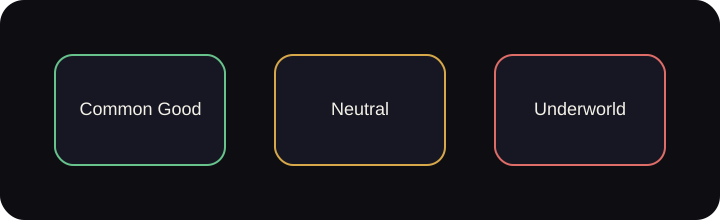
Common Good: make the city's reasoning reproducible
Common Good wins more reliably when multiple players can reproduce the same conclusion without sharing hidden truth. Protect credible evidence carriers, compare different channels, and build case files around integrity rather than volume. Publicly distinguish a weak lead from a vote-ready case. When your theory fails, revise it quickly; stubborn certainty makes an honest investigator look like a manipulator and gives Evil a ready-made countercase.
- Preserve investigators and protectors without demanding premature claims.
- Use map actions to test timelines, not to manufacture identity from proximity.
- Share enough public reasoning that another Good seat can continue after you are removed.
- Vote on case quality and urgency, never on hidden alignment information the voter could not know.
Evil: create plausible alternatives, not impossible stories
Evil strategy works when public facts remain compatible with more than one explanation. Attack the weakest link in a case—source integrity, timing, alternative routes, or the jump from clue to identity—rather than denying every visible event. Eligible roles can use entitled ally networks and shadow intelligence to choose targets, surveillance, or misdirection, but that information does not become courtroom evidence. Build a public explanation from facts the room can see.
- Do not have several allied voices repeat identical wording or timing.
- Let an overconfident Good accusation expose its own evidentiary gap before challenging it.
- Use market threat only when it advances a concrete action; flashy purchases create trails and attention.
- When sacrificing an ally is necessary, make the position consistent with your earlier public standard.
Neutral: make continued survival useful to someone
Neutral is not one alliance. Read the role objective before deciding whether you need survival, a contract, a target removed, cash, leverage, or another specific condition. Offer bounded cooperation that another player can evaluate without exposing the entire objective. Avoid being the easy compromise nominee: a strange vote, unexplained purchase, and vague defense can unite otherwise opposed factions against you.
- Choose temporary partners by overlapping goals, not assumed Neutral solidarity.
- Keep a consistent public reason for votes even when your private motive differs.
- Price contracts and risky actions against the cycles you realistically expect to survive.
- Remember that the Hitman is always unaffiliated and cannot gain an ally network through an override.
Plan across phases, not one click at a time
| Window | Question to answer | Useful commitment |
|---|---|---|
| Meeting and Day Action | What public or private fact would change my target? | Name the test before results arrive. |
| Stance and Market | Which risk, resource, or action window am I preparing for? | Set a cash limit and a two-cycle use plan. |
| Offense and Defense | What can counter, expose, or invalidate this action? | Check legal targets, map cells, equipment uses, and protection. |
| Outcome and Trace | What actually resolved, and which part is interpretation? | Record result, source, location, and uncertainty separately. |
| Trial and Defense | Is the case strong enough, or is delay risk driving the vote? | State evidence and urgency as distinct arguments. |
Scenario: the contested D4 timeline
A violence trace appears at D4. A private witness description partially matches two living players, and one of them publicly claimed to be elsewhere. Do not call the partial profile a positive identification. Ask for the claimed route, compare it with public movement, and seek a second channel such as timeline or financial evidence. If both players still fit, the correct mid-game action is a discriminating check—not a coin-flip nomination.
Scenario: shadow intel points to a protector
An eligible Evil role receives a corruption-network stance or action hint suggesting a player is defensive. That hint is useful for target selection but is not admissible proof in trial. The legal strategic conversion is to watch the target's public timing, plan an entitled action, or create a plausible public alternative. Saying “my secret network proves this player is the protector” exposes the source and asks the courtroom to accept information it cannot verify.
Build a courtroom case that can survive a defense
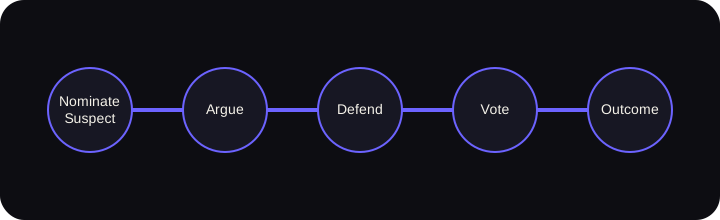
Use five parts, in order: event, source, connection, alternative, risk. Name the public event. Identify where the supporting information came from and whether it is public, private, or disputed. Explain the connection to the nominee. Address the best innocent alternative. Finally, state what the city risks by executing and by waiting.
Worked prosecution
“A disruption trace was recorded at E6 after the night outcome. The public movement record places Rowan on the E-file route, and a separate financial event conflicts with Rowan's claim of preparing for work. The innocent alternative is that Rowan arrived after the disruption. I want the timeline witness addressed before the final ballot; if it cannot be, waiting risks another disruption.”
This argument does not claim a role, does not turn proximity into certainty, and tells the defense exactly which link can break the case.
Construct a defense, not a denial
A defense should concede what is genuinely public, correct the inference, and offer a testable alternative. “I was on the route but after the outcome; the timeline channel can separate arrival from action” is stronger than “everyone is lying.” If you claim an ability, explain the expected visible consequence and why it was absent or ambiguous. If you offer a plea or hire counsel, account for the cash and resulting sentence rather than presenting the option as innocence.
Talking to the AI in court: what lands and what backfires
The other players read your trial chat and sort every line into two buckets. Social lines — greetings, praise, banter, jokes, insults, off-topic chatter — only change the room's tone; they never create suspicion or move a vote. Case lines — an accusation, an evidence claim, a vote push, a role claim, or a defense — are the only messages that shift the jury. Spend your words on case lines, and make each one survive a challenge.
Every public trial bubble also carries a small effectiveness badge — + persuasive, ~ neutral, − weak or backfiring. Treat it as live feedback: if your accusations keep reading −, you are asserting without a public anchor.
Five habits that persuade the room
- Anchor to a public event. Name the cycle, the cell, and what was publicly seen. "A body-evidence trace hit C4 last cycle" beats "I just know it's them."
- Say where it came from. State whether your information is public, private, or disputed. A whisper or DM is not proof — if you present private chatter as evidence, the room raises a "private source" objection.
- Offer the innocent alternative. Naming the one link that would break your own case reads as good faith and is harder to dismiss than blanket certainty.
- Do not overclaim. When a descriptor fits more than one living suspect, hedge and list the candidates. A single confident ID pulled from a vague description invites a call-out.
- Make shaky accusers commit. Ask "which cycle? which cell?" A player who dodges a real, posted question gets publicly flagged for dodging — but only when the question actually exists on the record, so ask it out loud.
Weak line, and the better line
You say: "Trust me, Vale is the killer."
The room does: discounts it — an assertion
with no public anchor reads as noise and your badge drops to
−.
Say instead: "A disruption trace hit C4 last
cycle and the movement log puts Vale on the C-route. Can
anyone place them elsewhere?"
Sourcing and vote timing
You say: "My source whispered that he's
mafia — everyone vote now."
The room does: objects twice — a private
source is not admissible, and rushing a vote on thin proof
reads as pressure, not a case.
Say instead: lay out event, source, and the
connection first; call the vote only after the link is on the
record.
Defending yourself
You say: "You're all lying." (or, as the
accused, you go silent.)
The room does: stays unmoved — a denial is not
a defense, and silence lets the story stand.
Say instead: concede the genuinely public
part, correct the inference, and offer a testable alternative:
"I was on the route, but after the outcome — the timeline
channel can separate arrival from action."
Two commands help you say these things precisely:
/claim <role> publicly asserts
a role (real or bluff — changing your claim later is remembered),
and /w <name> <message>
sends a private whisper. Keep whispers for coordination; the jury
only weighs what is said in open court.
Public evidence, private findings, and shadow intelligence
Public evidence
Visible outcomes, public logs, courtroom messages, ballots when the mode exposes them, and public movement or identity events can be cited directly. Even public evidence still needs interpretation.
Private lawful findings
A role may privately receive witness, scene, trace, dossier, or case-file information. You can act on it and may describe it honestly, but other jurors must judge your credibility and limits.
Shadow intelligence
Eligible Evil roles can gain surveillance, intimidation, corruption-network, infiltration, bounty, or whisper-network leads. These are actionable and can decay, but they are not trial-admissible evidence.
Strategy improves when private information predicts something public. If a private lead says a target may visit a watched cell, plan around the visit and evaluate the resulting event. Do not launder the lead by describing it as a public fact. The same rule protects fair play for every seat: AI and humans should reason from only the information their viewer or role is entitled to know.
Use the map to connect channels, not assign identities
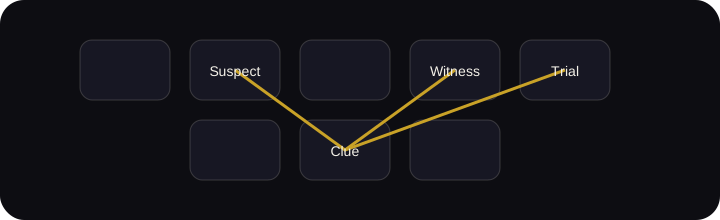
Build a location timeline: where the relevant action resolved, who was publicly or privately observed nearby, when movement occurred, and whether a stance such as Relocate changes the expected route. Remember that Relocate is selected in one cycle and resolves at the next cycle's day start; confusing declaration time with movement time can create a false contradiction.
Forensics spans scene, witness, financial, body, trace, dossier, and timeline channels. A partial profile is a preliminary finding, not a positive identity. Clue chains and case files become stronger when they connect multiple weak pieces across channels, verify integrity, and remain consistent across cycles. Old evidence can decay, and tampered or disputed material should receive less confidence until verified. Visibility cuts both ways here: staying stealthy hides your own movements and thins the trail you leave, while a loud, exposed posture (Reveal) makes bystanders notice you and profiles you faster. High-Perception seats — investigator roles and a watching posture — notice others and connect those weak pieces sooner than the rest of the table.
Scenario: two people match the witness
A witness reports a dark jacket and medium build, matching Ava and Micah. A careful player names both candidates and says the description is not a positive ID. Checking a ring, route, timeline, or independent residue category can complete the profile. Naming Ava alone because she already seemed suspicious converts an ambiguous clue into a false fact and gives the defense an easy credibility win.
Black-market choices: buy a line of play
A listing is valuable only if your role may legally buy it, your slot can use it, you can afford settlement, and its remaining uses matter to the match. Some eligible weapons support buy-now decisions; other listings resolve through bids and tie-break rules. Reserve enough cash for the consequences your role may face, including future market needs, legal support, or a valid plea path.
Good purchase
Your current defense is exhausted, a hostile action window is likely next cycle, and an affordable legal armor listing fills the gap. Set a maximum bid based on survival value and keep enough cash for the following cycle.
Bad purchase
You buy a second item for an occupied slot because it looks powerful, but it neither replaces a low-use tool nor unlocks a reachable action. The spending creates attention while your actual weakness remains.
Market behavior can itself become context. A bid is not proof of criminal intent—Good, Evil, and Neutral seats all use equipment—but a purchase that contradicts a public story is a fair question. Ask what function the item serves before claiming what role bought it.
Dice modifiers: improve the contest, never promise the result
Each side rolls Good Luck minus Bad Luck, adds effective modifiers, and compares totals. A winning margin of 1–2 is Standard, 3–4 is Strong, and 5 or more is Critical; ties are Neutral. Position, stance, equipment, protection, target state, role rules, contracts, and other conditions can change either total. Stacked situational modifiers use diminishing returns beyond the first few points, while some signature bonuses apply separately.
The strategic lesson is diversification. If your plan requires one action to reach a Critical outcome, it is fragile even with favorable modifiers. Prefer a plan where Standard creates a useful clue, Strong advances the main objective, and failure still teaches something about defense or timing. Read the displayed contest breakdown after the outcome; do not reduce it to “my Good Luck die was high, so I must have succeeded.”
Worked modifier decision
A player can Hunt for pressure or Lay Low to reduce exposure. If the target already has strong protection, one more offensive point may have less value than choosing a different legal target, changing the action's timing, or generating a corroborating clue first. Expected information value is part of the contest, even though it is not a numeric modifier.
Five worked mistakes and the better line
-
“The roll failed, so the actor lied.”
Why it fails: contests include an opponent and modifiers. Better line: verify that the action was legal and timed correctly, then compare both final totals and the visible outcome.
-
“They were near the scene, so they did it.”
Why it fails: the same location can contain an actor, witness, protector, investigator, or bystander. Better line: combine location with time and a second evidence channel.
-
“My private hint should decide the public verdict.”
Why it fails: shadow intel is not trial-admissible, and other private findings still require trust and limits. Better line: use the hint to predict or test a public event.
-
“The most expensive item is the best purchase.”
Why it fails: legality, slots, uses, cash reserve, and reachable targets define value. Better line: buy the cheapest tool that enables the needed two-cycle plan.
-
“A guilty vote means the player is gone.”
Why it fails: legal counsel and an active plea can change the sentence; an accepted plea means detention. Better line: wait for Trial Outcome and Cleanup, then recount the live and restricted seats.
Frequently asked strategy questions
When should Common Good reveal an investigative role?
Reveal when the claim changes an immediate protection or verdict, when another source can corroborate it, or when silence would waste a decisive result. Include the result's cycle, scope, and limits.
Should Evil always defend an allied player?
No. Automatic defense creates a readable network and can attach your credibility to a collapsing case. Use only ally knowledge your role is entitled to have, then choose whether defense, distance, or a consistent sacrifice best preserves the win path.
What is the safest Neutral strategy?
There is no universal Neutral plan. The safest line is the one that advances the specific role objective while giving at least one faction a visible reason not to nominate you immediately.
How many clues make a strong case?
Quality and independence matter more than a raw count. Several copies of one weak source can be worse than two consistent pieces from different channels with a verified timeline and integrity.
Is abstaining ever correct?
It can be, when the case is genuinely balanced and abstention does not hand an immediate win to a hostile plan. State what missing evidence would change your vote so abstention remains accountable.
Where should a new player start?
Read the complete rules guide, review the canonical role roster, then choose the focused trial, evidence, black-market, or dice guide for the system you want to practice before playing at verdictris.io/play/.