What you are trying to do
Each seat receives a hidden role, one of three broad alignments, and a win plan. Common Good players generally protect the city, investigate credible leads, and remove dangerous actors without sacrificing helpful seats. Evil players benefit from successful criminal action, fractured trust, and false conclusions. Neutral players pursue role-specific goals such as survival, contracts, leverage, or a particular end-state; they are not automatically a team. The Hitman, for example, is always an unaffiliated neutral freelancer rather than a member of an Evil ally network.
You rarely receive perfect information. The important skill is to separate what the city publicly knows from what your own role has privately learned, then choose actions and arguments that advance your objective without inventing certainty. A quiet player is not guilty merely for being quiet, and a failed action is not proof that its actor lied.
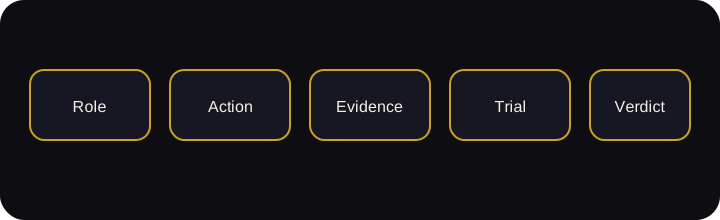
Setup: read your seat before reading the room
Choose a mode and player count, then read the role card shown to your seat. Classic Balanced includes the broadest baseline mix of stances, trace evidence, forensics, case files, the black market, district control, bystander reports, and political trial chat. Other presets may switch systems off or change their emphasis, so the live phase panel is always the authority for the current match.
Know your legal actions
Read each action's target, timing, cost, cooldown, and profile. Some abilities choose players, others choose map cells, and equipment can add actions that your base role does not have.
Know your visible identity
Your role is private unless the game explicitly reveals it. A public profession may also be a cover, including an Unemployed cover, so profession labels are clues rather than a reliable role list.
Know your objective
Alignment is the broad direction; the role card is the actual assignment. Do not assume every Neutral wants the same ending or every role should reveal itself to coordinate.
Before the first decision, pick one modest goal: preserve a useful ability, investigate a claim you can later explain, create a safe map route, or earn enough cash for a planned purchase. A concrete goal produces more useful information than clicking the most dramatic option available.
Every phase in a Verdictris cycle
The engine tracks the phases below individually. Players can understand them as six connected groups. Optional systems may make a phase brief or skip its player choice, but the sequence preserves a fair declaration, resolution, and courtroom order.
-
Seat and information: Lobby, then Meeting
Lobby prepares the match, seats, mode, and roster. Meeting is the information window: read the current city state, recent public events, private notices, resources, and the questions your role can answer before you commit an action.
-
Day planning: Day Action Declare and Stance Select
In Day Action Declare, eligible daytime actions are chosen and resolved. Stance Select sets your posture for the coming night: options such as Lay Low, Hustle, Hunt, Blend In, Relocate, or Prepare for Work alter risk, economy, stealth, or follow-up timing. Relocate is queued: the chosen destination resolves at the start of the next cycle's day rather than teleporting you immediately.
-
Resources and declarations: Black Market, Offense, Defense
Black Market presents legal listings, bids, and eligible buy-now choices when the mode enables it. Offensive Declare locks attacks, investigations, disruptions, control actions, and other proactive night choices. Defense Declare follows, allowing protection and reaction choices without revealing the final result early.
-
Resolution: Outcome Loading, Outcome, and Trace Check
Outcome Loading gives the engine and connected seats a synchronized boundary before results appear. Outcome replays the night's effects in the dedicated Outcome Feed. Trace Check then verifies trace pressure and aftermath that can affect whether a trial is warranted. The ordinary Event Log is not a substitute for the staged Outcome Feed.
-
Economy and court gate: Payout, Trial Gate, and Gathering
Payout settles income and cycle economy. Trial Gate evaluates qualifying pressure rather than forcing a courtroom every cycle. If the gate opens, Gathering assembles and synchronizes the courtroom; if no trial qualifies, the cycle proceeds to private Analytics.
-
Courtroom and reset: Trial through Game Over
Trial opens nominations and public argument. Trial Defense gives the selected nominee a final defense and supports lawyer or plea decisions. Deliberation resolves final ballots, and Trial Outcome presents the verdict and sentence. Cleanup finishes courtroom consequences. Analytics provides the private cycle review before the next Day Action Declare. When a win condition is resolved, Game Over replaces the next cycle.
Dice contests: Good Luck minus Bad Luck
A Verdictris roll uses two six-sided dice. The Good Luck die is positive and the Bad Luck die is negative, so a roll of Good Luck 5 and Bad Luck 2 produces +3. Both sides of a contest roll this way. Situational modifiers are applied, then the actor's total is compared with the opponent's total. A tie is neutral; a winning margin of 1–2 is Standard, 3–4 is Strong, and 5 or more is Critical. Negative final roll bands include Setback and, at −5 or worse, Botch. The particular action decides what each margin means.
Example: a Strong actor win
The actor rolls 5−2 for +3 and has a +1 situational modifier, finishing at +4. The opponent rolls 4−3 for +1. The actor wins by 3, a Strong margin. That is strong contest pressure, but the selected action's rules still determine the actual effect.
Example: defense reverses a positive roll
The actor rolls 6−4 for +2. The defender rolls 2−1 for +1 and receives +2 from an applicable defense, finishing at +3. The actor's roll was positive, yet the defender wins the contest by 1. Read both totals, not just the actor's dice.
Position, stance, role rules, contracts, equipment, protection, target state, and other conditions can contribute modifiers. Stacked situational bonuses have diminishing returns beyond the first few points, while certain signature bonuses are handled separately. Use the displayed breakdown as the authoritative explanation instead of trying to infer a hidden guarantee from one item or stance.
Evidence is not the same as suspicion
Evidence is a recorded clue or supported observation: scene residue, witness information, a financial trail, body evidence, trace evidence, a dossier, or a timeline connection. Evidence can vary in confidence, can be disputed or tampered with, and may grow more useful when independent channels corroborate one another. Case files reward coherent material, integrity, and cross-cycle or cross-channel support rather than raw quantity alone.
Suspicion is a conclusion players draw from evidence, public behavior, voting, timing, and motive. It helps you decide whom to question, watch, or nominate, but it is not proof by itself. Proximity is a good example: sharing a map area with an incident can create a lead, yet it may also describe a witness, protector, investigator, or unlucky bystander.
Stat glossary: the numbers and tags on your sheet
Most of these are read-outs, not automatic dice bonuses. A value only joins a roll when the action or defense says it applies; the displayed breakdown at resolution is always the authoritative explanation.
- Offense and Defense
- Contest modifiers, not stored points. Offense helps eligible attacks and pressure plays, including the contested gate when one participant tries to force a proximity fight. Defense resists those attacks and also resists proximity TALK pressure, reducing the chance that another participant can force a slip. Your stance shifts them — Hunt gives +1 Offense and Lay Low gives +1 Defense. An equipped accessory adds its listed +1 bonuses to the same modifier paths.
- Income
- The fixed contribution to your nightly cash payout. Economy, stance, profession, district, and an equipped Income accessory combine before Double Economy multiplication. Income is not a contest modifier.
- Stealth
- A derived covert modifier that aids stealth or sabotage actions and hides movement. When opposing players cross paths, each has a bounded chance to slip by: 8% base, plus 10% per Stealth, minus 8% per Reveal and 5% per the other passer's Perception, clamped from 2% to 55%. A successful evader avoids the normal encounter and receives one anonymous characteristic/profile lead in their private log and suspect board; the public log identifies neither passer. Blend In gives +1 Stealth, so its ordinary path-pass chance is 18% before Reveal or opposing Perception. Equipped Stealth accessories use the same bounded formulas.
- Reveal and Perception
- The counterweights to Stealth. Reveal comes from loud, aggressive, or already-spotted posture and makes you easier to notice and harder to slip past unnoticed. Perception describes how sharply the observer reads the street: investigator roles and a watching posture notice others more often, connect suspect profiles faster, and reduce the other passer's avoidance chance. An equipped Perception accessory adds to that observer-only value. These values never expose hidden roles by themselves.
- Heat
- Your exposure. Some locations, professions, stances, and risk checks read it, and crime raises it while laying low or relocating lowers it. Heat is not a universal roll modifier — a high-heat suspect is simply easier to track and pressure.
- Influence
- Active social standing and a spendable resource. Every successful influence-profile action grants +1 Influence once after resolution, capped at 5. Undermine Influence is excluded, so sabotage cannot farm or transfer standing. Stored Influence gives small bounded social, civic, courtroom, and proximity TALK benefits. A TALK participant uses the same bounded influence-profile contribution (influence ÷ 4, floored and capped), improving the chance to win the exchange and reach the Strong/Critical margins that make the other participant slip; the other participant's Defense resists that pressure. Public arguments weigh 1.00x at zero, rising 0.05x per point to 1.25x at five. Influence never makes evidence truer or changes raw vote counts. The shared Undermine Influence day action removes at most 2 points in one cycle and transfers nothing.
- Cash and Lives
- Cash funds black-market bids, equipment, contracts, and paid actions. Lives are your survival counter — reaching zero eliminates you, and your role sets the maximum.
- Accessories
- You have one Accessory equipment slot. Each Black Market accessory grants two permanent +1 character-sheet bonuses while equipped. Acquiring another replaces the current accessory.
- Reputation
- Your public standing with the city and the jury. Acting in line with your objective and staying clean in court raises it; betrayals, wrong accusations, and exposed crimes lower it (it cannot be driven to an unrecoverable low). It colors how much your courtroom words carry, lends a small, bounded edge for or against your overt civic day actions, and is tallied on the end-of-match report.
- Pressure and persuasion
- Two related read-outs. In a trial, the persuasion outlook (jury pulse) shows which way the room is leaning before the vote, moving only with public evidence, claims, and support. Across the city, criminal pressure is how much successful crime is squeezing the economy that cycle.
- Law and Criminal tags
- Investigations usually reveal a role tag category rather than the exact role. LAW marks order-keeping roles; CRIME (criminal) marks offenders. Other tags include MEDICAL, INFLUENCE, STEALTH, VIOLENCE, CONTROL, and INTEL. A tag narrows suspicion; it is not a confession.
The crime map and black market turn plans into trails
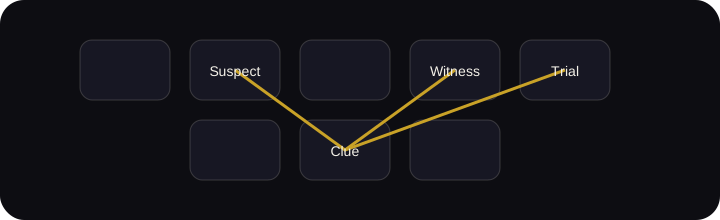
Crime map decisions
The map records city cells, districts, movement, action locations, and encounter opportunities. Nearby players may talk, pass, or engage when a live encounter calls for a response. Bystanders and taverns can produce private, limited observations; tavern rumors are deliberately anonymous and private rather than public proof. Death locations can also retain unconsumed loot. Treat the map as a source of testable routes and timing, not a role scanner.
Black market decisions
Market access is mode-dependent. Listings can support auctions, and some weapons may have an eligible buy-now path. Role restrictions, cash, equipment slots, remaining uses, and settlement affordability all matter. Bid for the job you need an item to perform, not for its dramatic name. Spending all your cash on a duplicate slot or a tool with no legal target can be worse than making no bid.
Before committing cash, answer three questions: Which reachable action does this unlock? In which coming phase will I use it? What public or forensic trail might that use leave? A purchase that has no two-cycle plan is usually an impulse purchase.
Trials, final defense, verdicts, and plea bargains
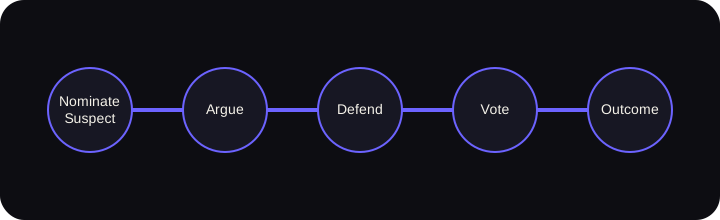
When the Trial Gate opens, players nominate eligible suspects and argue in the public trial channel. A useful accusation names the event, the evidence source, the connection to the nominee, at least one plausible alternative, and the cost of waiting. A useful defense answers that same structure with a better timeline; it does not rely on volume or a last-second role claim alone.
Whispers are restricted to the trial channel and use
/w <name> <message>. A whisper is private
coordination, not public evidence. If the room needs a fact to judge
the case, state a visibility-safe version in public rather than
claiming that an unseen private message proves it.
Spared or no fair nominee
A spare verdict leaves the nominee alive. A trial can also fail to produce a fair nominee or collapse without consensus. Neither outcome proves innocence; it only records that this courtroom did not impose execution.
Guilty verdict
An execute verdict normally removes the nominee and publicly resolves its consequences. Legal counsel may alter that path when its rules apply, so wait for the final verdict card rather than announcing a death from vote chatter.
Accepted plea bargain
A valid active plea can reveal a broad theme hint and, if the guilty path resolves through the plea, reduce the sentence to temporary jail instead of execution. The final card correctly reads DETAINED, not Executed or Spared.
Your first-match checklist
- Read the whole role card. Note the win condition, legal targets, costs, cooldowns, passive effects, and what is safe to reveal.
- Choose one two-cycle plan. Decide what you want to learn or protect now and what the next cycle should confirm.
- Check the current phase panel. Do not wait for Offense to discover that your action belonged in Day Action or required a map cell.
- Read both sides of a dice contest. Compare final totals and modifiers; a positive personal roll can still lose.
- Separate feeds. Use the Outcome Feed for staged aftermath, the Event Log for ordinary public history, and private notices only for decisions your seat is entitled to make.
- Write down one fact and one theory. Keeping those categories separate prevents a hunch from becoming a false memory.
- Enter trial with a timeline. Be ready to explain what happened, where the clue came from, and what else could fit.
- Let the final result finish. Pleas, counsel, detention, cleanup, and win checks can change what the votes alone appeared to promise.
Frequently asked questions
Does a failed action mean the player lied about acting?
No. A legal action can lose its contest, be blocked, meet a defense, or produce only a limited result. Test the claim against visible timing and outcomes instead of treating failure itself as proof of deception.
Is every private clue admissible in trial?
No. Private forensic findings may support your reasoning, but shadow intelligence is specifically actionable rather than trial-admissible. Public arguments should distinguish a visible fact, a private lead, and a personal theory.
Why did the cycle skip the courtroom?
Trials are conditional. The Trial Gate evaluates qualifying pressure and events after outcome, trace, and payout. If the gate does not open, the match advances through the private cycle review and starts the next day.
Can I trust another player with the same alignment?
Only when your seat is legitimately entitled to that knowledge. Role and network rules control ally visibility. Neutral players are not one shared faction, and the Hitman never gains allied network membership from an alignment override.
What should I do when I have only weak evidence?
Ask a narrow question, watch the relevant location or player, and seek a second independent channel. Weak evidence is useful for deciding what to test; it is dangerous when presented as a guaranteed identity or verdict.
Where can I play?
Open the browser game at verdictris.io/play/. The game surface is separate from this public rules guide.