A trial decides whether the public case justifies the risk
The courtroom does not reveal hidden truth on demand. It asks the table to judge a public record assembled from declarations, movement, action outcomes, visible evidence, testimony, voting behavior, and motive. A persuasive speaker can organize that record, but persuasion does not turn a private hunch into public evidence.
Every case should answer two questions. What becomes safer if the nominee is removed or detained? What becomes more dangerous if the table is wrong? Naming both risks prevents the trial from becoming a contest between confidence and panic.
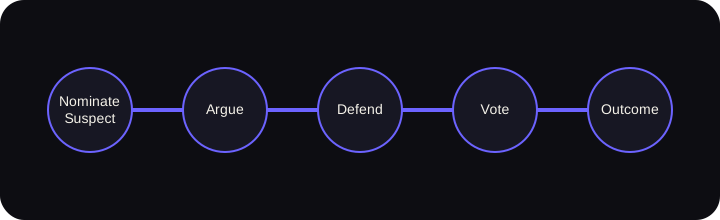
A fair nomination begins with an event, not a label
Start with the disputed event: an attack, suspicious route, financial trace, contradiction, repeated vote, or unexplained outcome. Then name the evidence that connects the nominee to it. “I dislike this player” is not a case. “Their declared route conflicts with two public events” is a question the room can examine.
Late game sometimes forces a vote before the evidence is complete. Say so plainly. “This is uncertain, but another hostile action ends the match” is more credible than pretending a weak clue became proof.
Build the accusation from event, evidence, motive, and risk
Event
Describe what happened, where it happened, and when it entered the public record.
Evidence
Name the independent sources and their limits instead of inflating one clue.
Motive
Explain why the nominee benefits without treating alignment as already proven.
Risk
Compare the cost of conviction, acquittal, detention, and delay.
Strong prosecution is falsifiable. It tells the defense which fact must be explained and tells jurors what answer would change the case. If no possible answer could matter, the room is hearing a conclusion, not an investigation.
A defense wins by replacing the timeline, not merely denying it
Address the strongest public fact first. Explain your declared goal, route, target logic, and expected result as they existed before the accusation. Then offer an alternative that accounts for more of the record with fewer convenient exceptions.
A role claim is useful only when its legal knowledge and observed actions fit. An impressive title cannot erase a contradictory route, and a failed contested action does not automatically prove the claim false. Give the room a test it can perform in the remaining time.
Weak denial and stronger defense
Weak: “That never happened. Trust me.”
Stronger: “I declared an investigation before the
move. The outcome confirms the attempt but not the target's identity.
Check who entered the district after my action and who first changed
the story from investigation to attack.”
Deliberation turns arguments into an accountable ballot
Jurors should summarize the strongest reason on each side before voting. Count independent sources, not repetitions. A rumor repeated by three speakers is still one rumor; a route, residue category, and contemporaneous declaration may be three different channels.
Abstention is a choice with consequences. It can be correct when the evidence is balanced and delay is survivable, but it should name the missing fact that would change the ballot. Silent uncertainty gives the next speaker control of the record.
Plea bargains change the sentence, not the meaning of the vote
A valid active plea may offer a broad theme hint and can reduce a guilty outcome to temporary detention when its rules apply. The room should still decide guilt from the case rather than voting to obtain a reward or force a reveal.
Spared
The nominee remains active. This records that the trial did not impose a guilty sentence; it does not certify innocence.
Executed
A guilty verdict normally removes the nominee once the final outcome resolves.
Detained
An accepted plea converts the guilty path to detention. The final verdict card reads DETAINED.
Public chat carries the case; whispers coordinate privately
Trial chat supports public argument and the private
/w <name> <message> command. A whisper can coordinate
questions or warn another player, but unseen text is not public
evidence. If the jury needs a fact, restate a visibility-safe version
in the public channel and accept that its source may still be disputed.
When speaking to AI jurors, include the event, source, nominee, and requested action. Concrete, sourced claims are easier to evaluate than insults, certainty without evidence, or a bare demand to vote.
Worked trial: the river-district disruption
A disruption is recorded after Rowan moves through the river district. Rowan previously declared an investigation. A witness profile matches part of Rowan's visible description, while a financial trace points to a second player who bought a compatible tool.
The prosecution should not say the profile proves Rowan caused the event. It should ask why Rowan's route, declaration, and timing fit the disruption better than the buyer's opportunity. Rowan's defense should explain the investigative route and ask whether the witness observed arrival before or after the event. Jurors then compare which timeline explains both the location and the financial trace.
The result may still be uncertain. The quality of the trial comes from preserving the two live explanations and choosing based on match risk, not from pretending ambiguity disappeared.
Five courtroom mistakes that weaken a real case
- Opening with the role guess. Establish the event and evidence before proposing identity.
- Using private knowledge as public proof. Convert it into a prediction the room can test.
- Ignoring the best innocent alternative. The defense will use the omission to discredit everything else.
- Treating a failed roll as a lie. Contested mechanics can fail even when the declaration was honest.
- Announcing the sentence before Trial Outcome. Pleas and legal effects can change the final result.
Trial FAQ
How much evidence is enough to nominate?
Enough to identify an event, connect the nominee, and explain why delay matters. Quality and independence matter more than raw count.
Does a spared verdict prove innocence?
No. It means the current trial did not impose guilt. Preserve the reasons and revisit them if later evidence changes the balance.
Where should I learn the evidence system?
Continue with the evidence and crime-map guide, then compare broader plans in the strategy guide.